
On learning about your own books weaknesses by studying a book in a similiar state
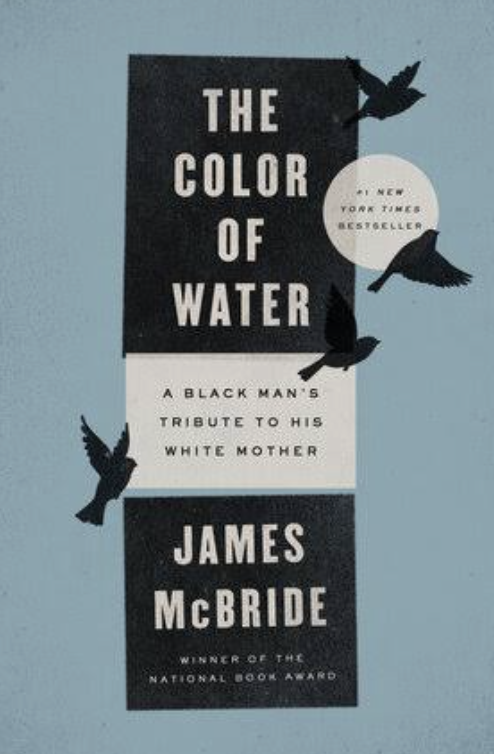 James McBride, author of The Color of Water has said that had he known The Color of Water would have been so successful, he would have written a better book. And yet, it amassed HUGE success and launched his career. Refreshing you from our last post, Riverhead published The Color of Water on January 23, 1996. It went on to spend more than two years on the New York Times bestseller list, sell more than two million copies, and appear in 16 languages. In 1997 it won the Anisfield-Wolf Book Award and was named an ALA Notable Book.
Why do I, Jennifer-who-teaches-good-writers-to-be-great, agree with McBride and say, for this post, that it’s “not a great book?” Well, aside from the acclaim and all the greatness here (see last post), the book is all told meaning it’s largely an exercise of the mind that is then supported by experience (body/scene). Not the other way around.
If your goal is an outward exploration of the world, then you’re most likely an immersion journalist. If your goal is to explore yourself, if you don’t mind being called an oddball, then you’re more of a memoir, as interested in your own transformation as the rest of the world’s. But I’d argue that there’s overlap there always is. The point is that the “self” matters, and it’s unrealistic – perhaps disingenuous – to believe it doesn’t. It’s not only the thing that matters, of course, but when I read a work of nonfiction, I have questions. More often than not, I want to know who’s telling the story and why. I want to know what’s at stake for the Writer. That doesn’t necessarily mean I need to know everything about the writer – it’s a matter of degree and intent and the nature of the project.
~ Robin Hemley, Author of A Field Guide for Immersion Writing
I share this quote because, in my mind as a teacher, Water falls somewhere between two forms. One is immersion journalism: “I’m interested in who my mother really is, and because I’m close to her and feel a deficit within myself, I’ll get her to tell me her stories. I’ll interview her.” The other is memoir, the exploration of the self through story. And for all of our purposes in this Studio, this book doesn’t “go the distance” because it’s not about me, the reader. It’s about Ruth and James. I can learn a lot by following the story. IE: Pick up that it is a sad, even tragic, history and respect how its new way to look at the America’s race struggle, which is brilliantly reframed. But, when you are writing a memoir, agents will want to know the answer to this question: How is this book about the reader?
So now, the work for us is to pull it apart and see what it was trying to be had he taken it a few more steps. And this is exciting because you are basically getting a teaching on diagnosing your own work after it reaches the point that we aren’t sure what to do with it.
Book Diagnosis Step One: Look at what is there, before you, on the pages
This is a two voice book. James. Ruth. James. Ruth. James. Ruth. And it moves through time. His fourteenth year to his adulthood. Her birth, travel to this country and being pulled through this series of interviews that leads to her final arrival home and connecting with the people of her past.
Chapter 1, “Dead.” This is essentially Ruth’s first interview, and it reveals the first wound: her mother. “The one person I didn’t do right by…”
Chapter 2. James watches his mother and senses something is off about her as she rides her bike through their Brooklyn neighborhood. He is 14. His stepfather has just died, and James is the youngest of the children Ruth had with Andrew Dennis McBride, who died while she was pregnant with him. So he begins the story not knowing who he is, who his father was, or what kind of man he’ll become. He’s on a quest, probably a subconscious one, for “the father.”
Chapter 3, “Kosher.” Ruth explains her parents’ arranged marriage. It came down to the dowry and the marriage contract under Jewish law, and she believes love had nothing to do with it. Marriage was a business. Her father came to America first, then sent for her, her older brother Sam and her mother. They lived with her grandparents in Manhattan. Her mother had a deeply traumatic background [polio? confirm], and [confirm which grandparents were in America, possibly both sets].
Chapter 5, “The Old Testament.” This one is about her father, an itinerant rabbi who made his living traveling, and about the contracts that ran Jewish life. The family moves often, from New York down to Virginia and through the South, before settling in Suffolk. There her father opens a grocery store. He takes Black customers’ money but treats them badly. [JL: confirm the details.] The family has no family life. The store is everything. This is where Ruth reveals the sexual abuse.
Chapter 6, “The New Testament.” James describes how his mother found the Christian church. His picture of her is a woman always in church and deeply in love with God and Jesus. Here the book locks in its central idea: God has no color, and God is love.
Chapter 7. Ruth’s brother Sam runs away, worn out by their life and the abuse he suffered at their father’s hands. He leaves in 1934, at 15. The father prospers while his family shrinks. He even gets a new set of teeth. There is also a younger sister, Aunt Dee Dee. Sam later joins the army and is killed in World War II. By then Ruth has left home, and she [JL: finish this thought: how and where does she learn of his death?].
Chapter 9, “Shul.” This covers school, Hebrew lessons, and the rituals her father kept going for the family and for the other Jews in the area. Ruth has a friend, Frances, whom she loves dearly because Frances accepted her when others didn’t. James parallels this with his own school experience.
Chapter 11, “Boys.” Ruth falls for Peter, a Black boy who is kind to her, and begins to break away from her family. She becomes pregnant. Her mother realizes what’s happening and sends her to New York to take care of “the problem.”
Chapter 13. In New York, with almost nothing said about it, her mother’s family sends her to her aunt [Mary? JL: confirm the name]. Aunt Betts figures out what’s going on, and a Jewish doctor performs an abortion without anesthesia.
Chapter 14. James writes about his stepfather’s death and the deep grief it sent his mother into.
Chapter 15. Ruth plans to stay in New York and enrolls in a school down the street from her grandmother’s house. Instead she ends up back in Virginia, where she learns Peter has gotten another girl pregnant. She is 17, in her last year of high school, and she realizes there’s no life for her in Suffolk. She is torn about walking with her class at graduation. [JL: I don’t think she went; confirm.] She leaves for New York the next day. Meanwhile her father is trying to marry her off, and her mother is getting sicker.
Chapter 17. Ruth arrives in Harlem, works in her Aunt Mary’s leather factory, and stays with her grandmother. This is where she meets Dennis McBride. She drifts toward some bad people who seem to be grooming her for prostitution, but Dennis watches out for her and keeps her out of trouble.
Chapter 19, “The Promise.” Ruth starts dating Andrew Dennis McBride, and this is when she turns to Christianity. She’s called home because her mother is getting sicker and her father needs help, and he is still trying to marry her off. He disappears for long stretches and has an affair with another woman. The marriage falls apart, though her mother depends on him completely. He divorces her mother and takes up with someone else. Dee Dee begs Ruth not to leave, and Ruth promises she won’t.
Chapter 21. Ruth learns her grandmother has died and no one told her mother. She wants to leave, and there’s a big fight with her father, who is still pushing to marry her off. She tells him she’s in love with someone else and wants to marry a Black man. He tells her that if she does, she can never come back. She leaves anyway, breaking her promise to her sister. Worst of all, she leaves her mother, and that is the most painful part.
Chapter 23. Ruth marries Dennis, joins the church, and the two of them build a deeper life together while facing constant prejudice [JL: and humiliation? discrimination? your notes said “meditation”]. They have many children. Dennis dies while she is pregnant, and she later meets her second husband, Hunter Jordan.
Chapter 25. James sets out to verify everything his mother has told him. He goes back to Suffolk and finds people who knew her. Then he takes Ruth back too, so she can see them and step outside the story of failure she has carried in her mind. She agrees to go.
Book Diagnosis Step Two: Who is the dominating presence (hero) and why?
Now we know how the book is shaped, and who is the dominating presence in the book (Ruth) the next question is tracking the change that takes place over the course of the story and nailing down the value like: Ruth started out Dead and over the course of the story Came to Life. So she was running the value line of love >Indifference > Hate > Self Hate (and leaning on Jesus to love her, who is so unlovable).
Supporting this isn’t an opinion, it’s what is in the lines of the book itself. Who does Ruth hate, and I mean hate with a purple passion?Her father. “I had no love for him.”
SIDE BAR EXERCISE: Count up the number of times she says this.
But what Ruth hates most is herself for failing people she loved. Her mother. Her sister. And yes, herself. In the end, she comes to acceptance of her self (self-love). Now, because this book is still in its raw form meaning the writer didn’t “write a better book,” or as I call it “go the distance” we don’t know if that is the final value line. In fact, other value lines that could work are as follows. Remember you follow from left to right not up and down with our principles of antagonism. (See Bones):
But overall, I’ll stick with Love.
Book Diagnosis Step Three: What is the plot?
Now we know the value line, we can dig deeper into who the hero is and the possible plot line taking shape. Does that mean it’s there yet? Kind of, but it’s accidental at this point. The writer fell into it without realizing what he did. Go back to the original quote: I would have written a better book.
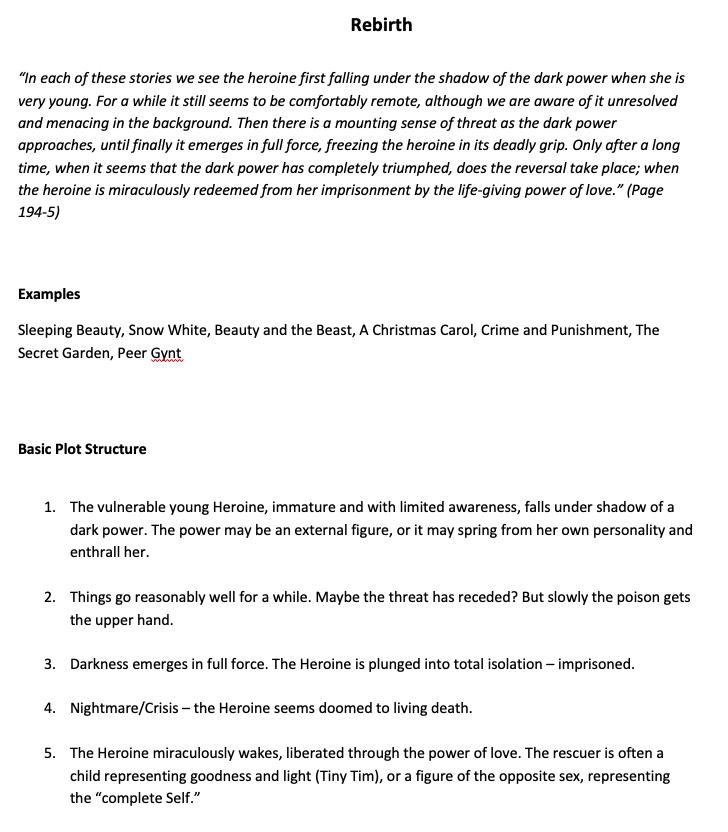
Ruth is the hero. Her journey is Rebirth. And she has been brought back to life by the child that is her son (See #5 on Rebirth chart). What she falls asleep to is the underlying goodness that was always there and understanding that she, and her father, are worthy of forgiveness. The Gospel Message. The dark power then? It’s fear. It’s Father. It’s the Old Testament God. And she can now become a true Christian in this way, not by an act of will, but one of realization that her son (the child) exposes her to. This journey then lightens Ruth’s spirit, though she was already redeemed. There’s a psychological redemption for her which is James’ gift to his mother.
Look at the plot breakdown yourself.

And last, I think James is running a coming-of-age subplot down the lines of Voyage and Return in that he falls down the rabbit hole of these interviews with his mother and gains what he needed in order to continue forward in his own life, that is understanding of “father” through the story of the mother. And in the end, he is three things, a saxophone player, a journalist/writer and a black man with something of a Jewish soul.
🤔 Questions to Ponder (and bring to class):
What do you think? Who is the hero in your mind? What is the proof-on-the-page? And what is the plot then? What is the value line? Again, bring proof on the page.
Count up the number of times Ruth talks about her father in this way, saying she has no love for him or that he is a terrible person. Add them up. They are important and we’ll talk about why in class.