
The Many Faces of a Woman in A Prayer for Owen Meany by John Irving.
The Problem This Lesson Solves
Something I hear a lot from newer writers is: I already described her in Chapter Two, why would I describe her again? as if we meet someone once in life and never have to look at them again.
That’s not how we see the people in our lives, and it’s not how the best fiction or memoir works either. A character worth writing is a character who accrues, scene by scene, and who a sharp reader can watch change, or notice pointedly not changing, which is its own kind of information.
A Prayer for Owen Meany is a strong teaching text for this because Irving does do a lot with his characters over time. He gives us relentless and progressive character descriptions throughout.
The close reader of this book would do well if they picked just one character and tabbed the pages where they are described throughout the course of the book, and make note because that’s how it is done. That’s how it looks. And, in many ways, that’s the whole teaching.
But let’s take this a layer deeper because something interesting is going on in this book that I hadn’t noticed until I read it as an older woman. Toni Morrison described her writing as being outside the “white gaze,” and I suppose I read Owen, this time, outside “the male gaze.” I’m almost 63, the phase of life when I am not invisible to men anymore. Too old. And frankly, being invisible is quite a relief because I can now see how “the male gaze” made a lot of what Irving did in this book acceptable, even a kind of bench-mark of acceptable vs. unacceptable femininity back when the male gaze mattered to me, even defined my experiences and perceptions.
What I noticed, again and again, is that Irving disallowed his female characters of true complexity and even, I would argue, humanity. These women are cut outs and stereotypes. They are . . . in a word, flat, and in the end, rather predictable and dusted away as irrelevant to the greater overall story. Others are pinned to a single note and never move again.
Look, this is not a scree against Irving, or a call out about sexism or anything near that. You cannot push the tide, but rather, you can notice it and make note. We all do this in our own writing, too. Man or woman. We box up our characters because it’s easier at time. Or because we are tired out as writers. By looking at what Irving is doing here, and how blatant it is, we can ask ourselves what we want to do within our own work.
Booker’s Toolkit: Character as Role
This handout from Bones (Class Six, on Character Definitions) gives us the scaffolding for the conversation. Print it out and see how Booker argues that characters in stories tend to fill archetypal roles: the Light Father, the Dark Mother, the Trickster, the Child, the Light and Dark Other Halves. Each archetype is two-sided, a positive expression of the role and a shadow expression where “the intervention of the ego” corrupts it.
Remember that an archetype is a starting position, not a character. The question that makes a character interesting is what a writer does with that position over time. Does the Light Mother stay comfortably in the background, or does something happen to complicate her? Does the Trickster’s role in the hero’s life change once the trick has worked? A character who never leaves their assigned archetype is a placeholder, and perhaps a stereotype. A character worth reading has been let loose from it, even partway.
Case Study One: The Unmovable Mary Beth Baird
Mary Beth Baird gets exactly two real moments in the novel that bookend the whole thing. As a child, she plays Mary in the Christmas pageant during the chaos of Owen’s Ghost of Christmas Yet to Come collapse. Afterward, she’s frantic, convinced the entire disaster was somehow her fault. Then she disappears from the book almost until Owen’s funeral, decades later, when she’s an adult with children of her own. She approaches John at the committal and asks him if he remembers lifting Owen over their heads in Sunday school, how light he was.
Notice what didn’t happen in between. We don’t get her at Gravesend Academy, her reaction to Vietnam, her marriage, her politics, anything that would tell us who this woman actually became beyond his bitter commentary on her. And in this story, she’s given exactly two functions: to be a frightened child near Owen, and to be a grown woman who still remembers how light he was. She exists entirely in relation to Owen’s mythology. She has no arc of her own; she has two data points that rhyme. And she is, in both cases, contemptible in John’s eyes.
This is what an unchanged character looks like on the page. Mary Beth Baird is flat by design, because her only job in the book is to reflect Owen’s weight, literally and symbolically, at two distant points in time. And perhaps to get in a dig at this woman to woman Owen showed such remarkable grace.
Case Study Two: Hester, the Character the Framework Can’t Hold
Now put Hester next to her, a character who resists charting. She’s introduced as a wild, sex-crazed cousin forever embittered by her parents favoritism toward her brothers that she, forever, punishes them for and who becomes Owen’s lover (making her his Other Half but light or dark? She seems like the tempter pulling him off mission, so I’d say dark, and yet she says she loves him and will have his child…an odd character indeed). But there’s also an incestuous thread in her early scenes with John that never resolves into anything. Finally, she becomes a Vietnam-era radical and then a famous, embittered rock star, unmarried, and still tethered to Owen’s memory for the rest of her life through her lyrics. She is, in the end, the female other half of John in the tragic sense.
She’s the only woman in the book who does change across every stage of it but ends up alone, tragic and unresolved. That she was allowed the quiet moment of playing a game of Monopoly early on, at peace in her room with the young John, is proof that Irving could write complexity in a female character but that is taken away the moment she’s the barfer who steps out of her panties to pee and never gets them back. Endless humiliation for Hester-the-Molester as she’s named by her brothers. Forever doomed.
That’s the teaching point. Hester is what happens when an archetype gets loose from its box. She’s harder to summarize in one sentence than Mary Beth Baird, and yes, there is more movement for her throughout the story but in the end, the same tragic fate mirroring John’s tragic stance.
Why This Happens: A Pattern, Not an Accident
Once you notice this, you can’t stop seeing it. Nearly every woman in the book gets sorted quickly into one of two boxes: the Madonna (Tabitha, Mary Beth Baird, Katherine Keeling) or the ruin (Barb Wiggin and Mitzy Lish as tormenting flirts; Hester as a “wreck,” in her own words, by the end). Tabitha doesn’t get to keep her Madonna stance for long though, does she. The dress, the dishonesty, the illicit affair. Even she is force, in death, to toggle that odd, discordant line. Grandmother is the one exception, known for her wit and commentary and old world values but even she is not immune, going crazy in the end and tormenting her housekeeper with the wigs.
Let’s take a closer look:
| Character | Archetype (Booker) | Textual Evidence | Fate |
|---|---|---|---|
| Tabitha Wheelwright | Light Mother-ish | The rock of security, idealized, warm, beloved by everyone. Removed before the story even starts. | Killed by the foul ball at 11. Never gets to be more than a memory. |
| Katherine Keeling | Light Other Half (unclaimed) | The nearest thing John has to Booker’s “center to whom the hero is drawn.” Wise, kind, witty, alive with family and faith. | Alive and thriving, but John can’t unite with her. He remains the barnacle, not the partner. |
| Hester Eastman | Light Other Half (Owen’s) / Dark Other Half (John’s) | Owen’s actual lover; also the cousin John has an unresolved incestuous charge with early on. The one woman who resists a single box. | Becomes a famous, embittered rock star. Unmarried, alone, tethered to Owen’s memory for life. |
| Mary Beth Baird | Child-adjacent / Madonna figure | Plays Mary in the pageant. Two scenes only, decades apart, both defined entirely by her nearness to Owen. | Grows up, has kids, but the text gives her no arc of her own. |
| Harriet Wheelwright (grandmother) | Dark Mother (softened) | Stoic, controlling of the household; keeps John from Sawyer Depot the Christmas after Tabitha’s death “so they won’t be too lonely.” | Survives, but administers rather than nurtures. |
| Martha Eastman (aunt) | Light Mother (background) | “Conventionally feminine,” “perfectly mild,” overwhelmed by grief and disbelief at both funerals. | Static; exists to register emotion, not to act. |
| Barb Wiggin | Dark Other Half | “Brash, backslapping redhead” who co-directs the pageant, clashes with Owen’s authority, and gives him an unwanted erection that John reports to Dan in distress. | No resolution given; recedes once her scene is used. |
| Mitzy Lish | Dark Other Half | Grouped with Barb Wiggin as a flirt who torments the boys sexually and offers nothing real. | Same as Barb: functional, then gone. |
| Mrs. Meany | Dark Mother (silenced) | Never leaves the house, supposedly allergic to dust; barely speaks in the entire novel, until one line breaks a silence John notes has lasted since Tabitha’s funeral. | Dies by fire, wrapped in the American flag from Owen’s memorial, an almost unbearably literal “grizzly end.” |
| The Nuns | Light Mother (collective, unindividuated) | Never named. They shepherd the Vietnamese orphans, hand the boys to Owen and John’s care, and witness his death; one finds him in the sink, arms gone. | No fate of their own; present only as a caretaking chorus at the most theologically loaded moment in the book. |
| Lydia | Servant figure, body as symbol | The Wheelwrights’ longtime cook and housekeeper. | Loses a leg to cancer; requires two new maids to be hired just to care for her. Her body, like so many of the women’s, is diminished physically as the price of her presence in the story. |
| Germaine (maid) | Parody of “feminine intuition” | One of the maids hired to help care for Lydia; reads ordinary events as signs of supernatural influence over human lives. | Played for comic relief; her superstition is a running joke, not a perspective taken seriously. |
| Mrs. Hoyt | The one real exception | A widow who loses her son Harry to Vietnam, becomes a genuine anti-war activist, and counsels young men on how to evade the draft. She’s also the person who first teaches John that criticizing the president isn’t unpatriotic. | Given an actual political position, agency, and ongoing action in the world, arguably the only woman in the book allowed to have public conviction and grief at the same time. |
| Amanda Dowling | The other real exception | A young wife who actively challenges gender norms, cross-casts herself in Gravesend productions, protests girls’ exclusion from Little League, and argues that books like Wuthering Heights teach women to submit. | No punishing fate attached; she’s mildly mocked for earnestness but never harmed, silenced, or mutilated. |
The real pattern is that every woman in Owen Meany is given beauty or brains, purity or sexuality, grief or action, but rarely holds more than one of these at once, the way Owen or even John and Dan are allowed to.
This from our Character Definitions handout:
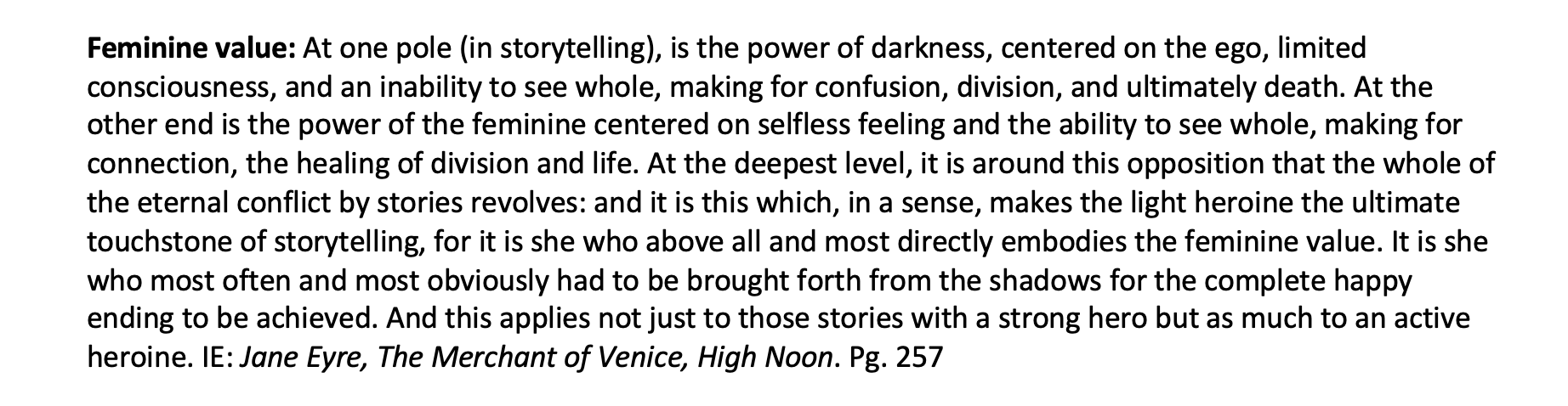
The light feminine in Owen Meany is killed at the beginning of the book (the mother, Tabitha) and then turned into a liar, sexualized repeatedly by Owen as having the best breasts of all the mothers and the best figure. And in the end? In the end, the figure of her that remains (the dressmakers dummy of her perfect figure) is cast out to sea. And it is this act that sets both Owen and John adrift in an odd way.
And it’s not just this book either: In The World According to Garp, Jenny Fields, Irving’s famous feminist mother-figure, is written as essentially asexual, uninterested in men or sex entirely, except for the single act that conceives her son: she rapes a dying, brain-damaged soldier who cannot consent. It’s an extraordinary founding image for Irving’s whole body of work, purity and violation fused into a single act, and Jenny herself is later assassinated. Even the founding mother of Irving’s fictional universe doesn’t get out clean.
Did Irving do this consciously? Honestly, for our purposes, I don’t need to go there. Leave that to Booker and his commentary about this lack of consciousness in writers in the second half of The Seven Basic Plots.
What matters for us, as writers, is seeing how the feminine–which is the core of a story either turning up as heroic or downward as tragic–is twisted in this author’s hands. For the writer looking close, it is yet another marker of how Owen Meany is a tragedy in the end. Remember: The light heroine is the ultimate touchstone of storytelling for it is she who embodies selfless feeling, the ability to see whole, makes for connection and heals all division and life. Without her in a story, you have no heroic outcome.
The MAJOR Takeaway for Your Own Work
A character doesn’t earn a place in your story by being described once and staying still. Go back to your own manuscript and ask, scene by scene: does this person change and how are you showing this change. This is not first draft work. Or even second. It’s the polish that comes when it’s all done and you are putting on those final touches that make your book truly remarkable, new, interesting and even enlightened. But you can be asking, in the drafting phase, the following questions: Do I know something new about them that I didn’t three chapters ago? Or have I quietly parked them in a box, Madonna, villain, sidekick, and stopped looking at them at all?
🧐 PONDER / WRITING PROMPT:
Pick one character from A Prayer for Owen Meany other than John or Owen, and track three scenes they appear in, start to finish.
Ask:
- What do they do or say in their first appearance? What do we assume about them from it?
- Do they say or do anything in a later scene that contradicts, complicates, or deepens that first impression? Or are they only ever giving us the same note?
- If you had to describe them in one sentence at their first appearance and one sentence at their last, would those two sentences be different? If not, what would you add to make them different?
When a teaching becomes a prompt for week three of our study: Now turn the question on your own work and choose one character from your own manuscript, doing the same exercise. If you can’t find a difference between their first sentence and their last, that’s not a failure, it’s information. What could you add to their next scene to give them somewhere to go? Write up your discovery as an exercise and bring to our third week of discussion about his book which are our Oct. 21/22 classes
Looking forward to the conversation, Jennifer 🐦⬛